




Date: 26 February 1997; 10.45am
Camera: (analogue) Minolta compact with negatives and scanned
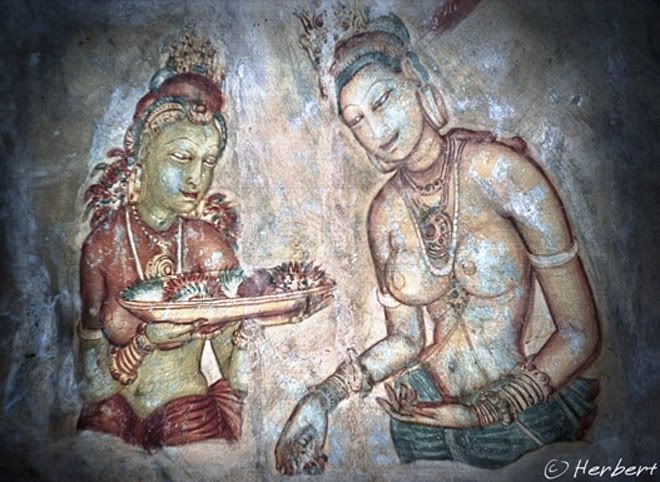
The Sirigiya complex was built in the 5th century. It was the site of an ancient capital. Its name is derived from "Sinha-giri" or "Lion Mountain". It consists of a volcanic rock rising starkly from the surrounding plains. The Sirigiya site has the remains of a palace on the flat top of the rock, a mid-level terrace that includes a Lion Gate and a mirror wall with its frescoes of maidens (above picture), a lower palace that clings to the slopes below the rock, and walls and gardens that extend hundreds of metres from the base of the rock.
A major attraction of the site is the remainder of the frescoes of maidens. There are only four left of the supposedly 500 original frescoes. The origins and nature of the paintings is still subject of much controversial debate with different theories. For a good concise read of the site, see here.


Date: 14 March 2006; 11.30am
Camera: Canon 300D with kit lens
Lausanne is the home of the International Olympic Council as well as the home of the one-and-only Olympic Museum. The museum has many interesting Olympic-related displays and paraphernalia. One of the cleverest is this statue of three cyclists where their five (only five) wheels are aligned to produce the Olympic Rings.
Date: 12 July 2007; 10.45am
Camera: Canon 400D with Sigma 17-70/f2.8-4.5
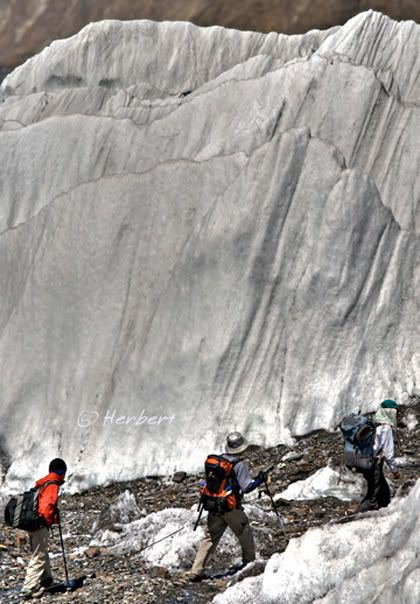
The effects of wind and sun on glaciers over the centuries create natural wonders such as these icy outcrops protruding from the rock-strewn glacier. The Ice Sharks (they look like the fins of sharks) can be as high as 50m. Such Ice Sharks are distributed over a section of the Baltoro Glacier on the Concordia trek to K2 Base Camp. All trekkers have to navigate their way between such Ice Sharks on the way to Concordia.
Technorati Tags: Concordia,Pakistan,Baltoro Glacier,Goro II Base Camp
Date: 29 April 2001; 4.20pm
Camera: (analogue) Canon 500N with slides and scanned
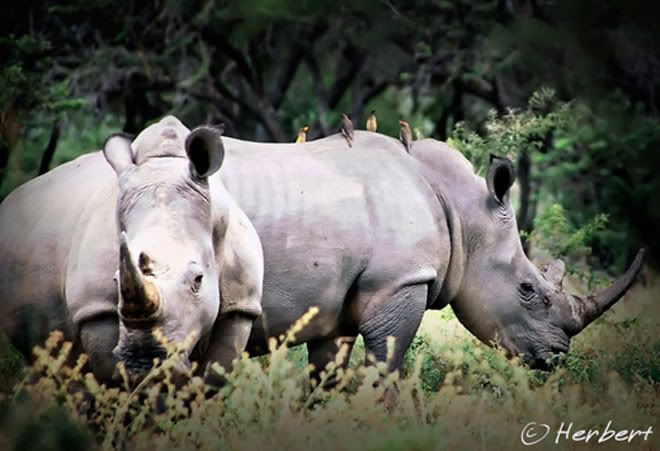
Matobo National Park is more well-known for its dramatic landscape of smooth whale-back garnite hills and ancient rock paintings. However also within its boundaries live some of the less than 2,500 black rhinoceros that is believed to be still alive today. Black rhinoceros is a highly endangered species (in fact one of its subspecies is believed to be extinct) often being poached for its horns. The name is actually a misnomer as the animal is more white-grey than black. For some reasons, birds like to hitch a ride on rhinos' backs.
Quite often there is a need to enhance the contrast in a digital photo to make it "pop out" so to speak. The more common technique to achieve that has been either to use the Level Adjustment to push both ends of the curve closer or to apply an S-curve to the image. Both techniques provide quite good results by improving the mid-tones but lacking details in the shadows and highlights. With the new Photoshop Camera Raw 4.3, the Clarity slider also provides pretty good result.
Personally I use the Unsharp Mask to enhance contrast in images with good results. I learnt of this technique from a forum discussion a couple of years ago. It is simple and effective. Simply select Filter\Sharpen\Unsharp Mask and use the following settings as a start:
Amount -20%
Radius - 50
Threshold -0
If it is not satisfactory, just play with the Amount and Radius to achieve the result that you want.
Date: 23 December 1996; 3.20pm
Camera: (analogue) Canon EOS 500N on negatives and scanned
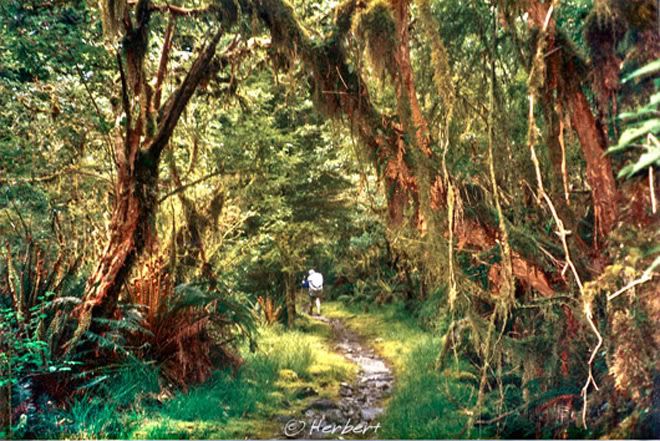
Perhaps the most well-known trekking destination in NZ, Milford Track is a 4 day track that can only be walked from one direction, from Glade Wharf to Milford Sound between late October and late April. At any one time there are a maximum of only 160 trekkers (or trampers as they are called in NZ and Australia) on the track- a maximum of 40 independent trekkers is allowed to start the trek every day. This means that at any time over the duration of the trek, a trekker will only meet the same 39 other trekkers who started on the same day as him/her.
Milford Track deserves its reputation as one of the most beautiful independent tracks in NZ. One can see beautiful lush valleys of beech, flowers, Moses, lichens as well as alpine lakes and tussocks, snow peaks, beautiful waterfalls over the 4 days of relatively easy walking. The scenery is even more spectacular after rain as waterfalls just tumble down the walls of the whole valley. However there are a couple of myths about Milford Track.
Myth number 1: one need to book 6 months to a year ahead to get on the track. Milford Track is popular but it is still possible to get on the track if one have a few flexible dates especially if one is trekking alone or with just another person. There are normally some vacancies on most days- just contact the Department of Conservation to check or check and book online here.
Myth number 2: it is impossible to take a bad photo of Milford Sound (of which Milford Track is located). Whilst the Track is amazingly beautiful in every way, one still needs the cooperation of Nature. Milford Sound is one of the wettest places on Earth and so one's photo opportunity is quite often wrecked by the trustworthy showers. Even at the Mackinnon Memorial snow peaks are often shrouded in mist.
 Dec-Feb12
  Any recommendations, suggestions or feedback are welcome. Click icon to email me.